This work presents a blindfold-integrated system capable of measuring in real time the residual light reaching the eyes during visual deprivation studies, enabling precise quantification of experimental darkness levels. The results show that blindfold fit directly influences the amount of residual light, providing a useful tool for improving experimental control and reproducibility in perception research.
What motivated us to conduct this study?
In many perception and neuroscience studies, blindfolds are used to eliminate visual information. This is a common strategy when researchers want to investigate questions such as how perception changes during temporary visual deprivation, or phenomena related to consciousness, attention, and sensory integration.
However, a simple yet fundamental question is rarely asked: How do we know that a blindfold is actually blocking all incoming light?
We often assume that if a person experiences darkness, then no light is reaching their eyes. From a physical and biological perspective, however, these two things are not necessarily equivalent. Even when we believe we are in complete darkness, small amounts of light may still penetrate the blindfold due to its fit, facial anatomy, or environmental conditions.
Most studies involving visual deprivation do not quantify this potential light leakage. As a result, an experimental variable that may be important remains hidden and uncontrolled.
Starting from this question, we developed a system capable of measuring, in real time, the amount of light reaching the inside of a blindfold used in scientific research.
How did we do it?
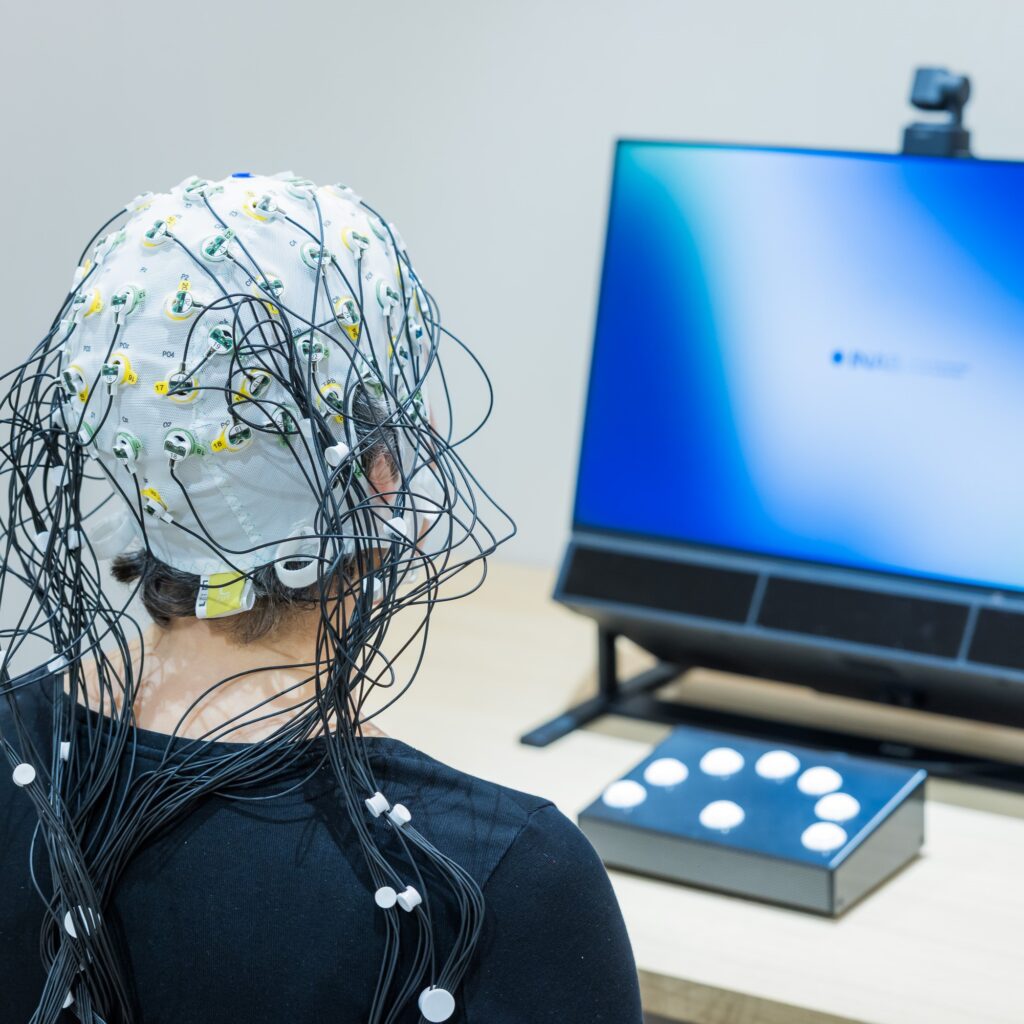
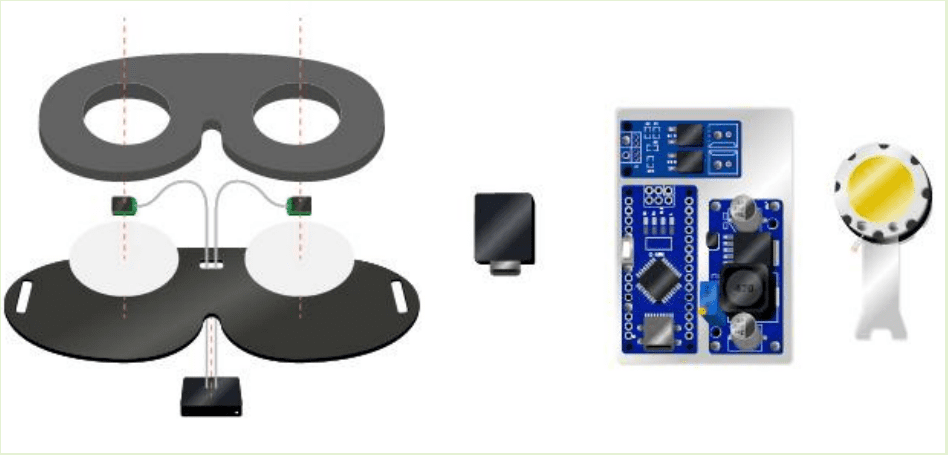
We designed a light-detection system integrated directly into a research-grade blindfold. To achieve this, we incorporated two highly sensitive sensors—one positioned in front of each eye—capable of detecting illumination levels in the microlux range, meaning extremely small amounts of light.
The device was designed to continuously record the light present inside the blindfold and transmit the data in real time to a computer. In addition, we developed calibration procedures that allowed us to convert the sensors’ signals into reliable and physically comparable measurements.
Once the system was built, we evaluated it in 67 adult participants. We examined how the amount of light detected varied under different blindfold fitting conditions.
Two situations were compared. In the first, the blindfold was adjusted only to the minimum level required for participants to report that they could no longer perceive light. In the second, the blindfold was fitted slightly more tightly.
This allowed us to investigate the extent to which small differences in blindfold placement could alter the actual amount of light reaching the eyes.
What were the main findings?
The results showed that darkness was not the same for all participants. Even when individuals reported perceiving no light whatsoever, the sensors detected small amounts of residual illumination inside the blindfold. Moreover, this residual light varied across individuals.
One of the most relevant findings was that a tighter blindfold fit significantly reduced the amount of light detected. In other words, small differences in how the blindfold was worn could alter the actual degree of visual deprivation.
We also observed differences between the left and right sides of the blindfold. This suggests that light leakage is not necessarily distributed uniformly and that anatomical factors or subtle asymmetries in the fit may influence the amount of light reaching each eye.
In addition, the system demonstrated high sensitivity and precision, successfully detecting extremely low levels of illumination and capturing very small changes in experimental conditions.
Taken together, these findings show that the amount of light present inside a blindfold is not a constant, but rather a measurable variable that can vary across individuals and experimental sessions.
Why does this matter?
At first glance, this may seem like a minor detail. Yet science often advances precisely when we stop taking seemingly obvious assumptions for granted.
When a participant reports being in complete darkness, does that mean that no light is reaching their eyes? Or does it simply mean that the amount of light present has fallen below their conscious perceptual threshold?
The distinction is important, particularly in studies of perception, consciousness, and sensory deprivation, where small variations in visual stimulation could contribute to the variability observed between individuals or across studies conducted in different laboratories.
This work offers a way to transform an assumption into an objective measurement. Rather than assuming darkness, it allows us to quantify it.
Beyond its methodological implications, the study also invites us to reflect on a broader question: our subjective experience does not always accurately reflect what is physically happening in the environment.
We may feel that we are in complete darkness and yet still be receiving visual information.
Perhaps the question is not only how much light exists out there, but how much of that light actually reaches us—and how much of it we are capable of becoming aware of.
Ver publicación