ABSTRACT
Brain-computer interfaces have promised to let people control machines with their thoughts, but they have a fundamental problem: brain signals, especially those captured without surgery, are noisy and imprecise. Most research has tried to build better decoders to extract cleaner commands from the noise, but there’s a limit to how much that helps. A recent study took a different approach. Instead of trying to decode the brain perfectly, researchers added an AI copilot that watches the situation, guesses what the user is trying to do, and blends its prediction with the brain’s signal. A paralyzed participant went from zero to ninety-three percent success controlling a robotic arm. Not because the brain decoder got better, but because the AI learned to meet the brain halfway. The interesting part isn’t the technology itself, it’s the idea: maybe the future of brain-computer interfaces isn’t brain control, it’s brain-AI collaboration.
If you’ve ever used an AI assistant to help you write code or draft an email, you already know the basic idea: you express what you want, and the AI figures out the details. You stay in control, but the AI handles the hard parts.
Now imagine the same thing, but instead of typing, you’re thinking.
And instead of writing code, you’re moving a robotic arm. That’s essentially what a team of
researchers at UCLA, led by Sergey Stavisky, built and published earlier this year in Nature
Machine Intelligence (Lee et al., 2025). And the results were striking.
THE PROBLEM: BRAIN SIGNALS ARE MESSY
Brain-computer interfaces (BCIs) have been around for decades. The idea is straightforward: record electrical signals from the brain, decode what the person intends to do, and translate that into an action, like moving a cursor on a screen or controlling a prosthetic limb.
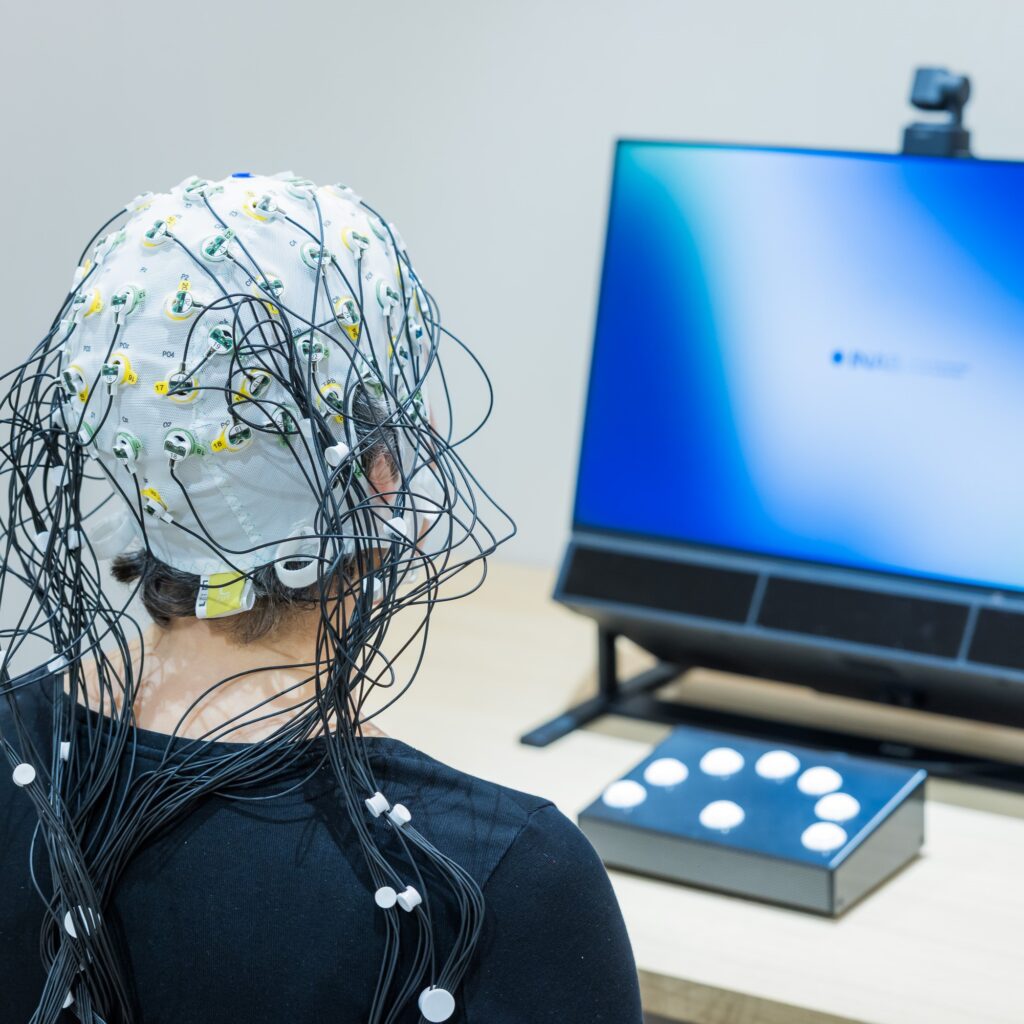
The problem is that brain signals, especially the ones you can pick up without surgery, are noisy. An EEG cap sitting on your scalp is reading the combined activity of billions of neurons through skin and bone. It’s a bit like trying to understand a conversation inside a stadium by pressing your ear against the outer wall. You can tell something is happening, but the details are blurry.
Because of this, non-invasive BCIs have always been slow and imprecise. Users get tired. Errors accumulate. And for people with paralysis (the ones who need this technology the most) the gap between what they want to do and what the system actually does can be frustrating.
Most BCI research has tried to solve this by building better decoders: smarter algorithms that can extract a clearer signal from the noise. That helps, but there’s a limit to how much it can do. The signal is just not that clean. So the UCLA team asked a different question: what if the AI didn’t just decode the brain, but actively helped?
THE IDEA: SHARED CONTROL
The UCLA team introduced what they call an “AI copilot” for brain-computer interfaces. Here’s how it works.
The person wears a standard EEG cap (no surgery, no implants). The cap has electrodes that sit on the scalp and measure tiny electrical signals produced by brain activity. These signals reflect patterns that change depending on what the person is trying to do (for instance, imagining moving your left hand produces a different pattern than imagining moving your right hand).
A decoder (a machine learning algorithm trained on the user’s brain data) translates these patterns into a direction: “the user is trying to move the cursor toward the upper left.”
That decoded signal is rough: it gets the general direction, but not with much precision. And here’s where the copilot comes in.
Instead of passing that noisy command directly to the cursor, the system also runs an AI that watches the screen, sees what the targets are, and makes its own guess about what the user is trying to do.
Then the two signals (the brain’s intention and the AI’s prediction) are blended together. The brain stays in charge of the big picture (“I want that target”), and the AI smooths out the path, corrects small errors, and fills in the precision that the EEG signal can’t provide.
Think of it like driving with lane assist. You decide where to go, the car keeps you from drifting.
THE RESULTS
The team tested this with several people, including a participant with severe paralysis who could not use their hands.
Without the AI copilot, this participant tried to hit targets on a screen using only their brain signals. The success rate was low, and controlling a robotic arm to move physical blocks was essentially impossible.
With the AI copilot turned on, the target hit rate increased by nearly four times.
And the robotic arm task? The participant went from zero percent to ninety-three percent success. They could pick up blocks and move them to a target location, something they could not do with the brain alone.
That’s not a small improvement. That’s the difference between a technology that doesn’t work and one that does.
WHY THIS MATTERS BEYOND THE NUMBERS
The most interesting part of this paper is not the results. It’s the shift in how we think about BCIs.
For years, the dream has been “pure” brain control: the brain commands, the machine obeys. That’s a beautiful idea, but it assumes we can decode brain signals perfectly. We can’t, at least not yet, and especially not without surgery.
The copilot approach says: we don’t need perfect decoding. We just need enough signal for the AI to understand your intention. The AI can handle the rest.
This is the same insight that made AI assistants useful in everyday life. ChatGPT doesn’t read your mind. You give it a rough prompt, and it fills in the gaps.
The BCI copilot does the same thing, just with brain signals instead of text.
nd because the system uses a regular EEG cap, it’s wearable. No surgery. No risk. That makes it realistic for everyday use in a way that invasive BCIs are not, at least not yet.
WHAT IT CAN´T DO (YET)
To be clear, this is not mind reading. The system doesn’t know what you’re thinking. It knows you’re trying to move in roughly a certain direction, and it uses the visual context of the screen to help.
It also works best when the environment is structured: a screen with defined targets, a table with blocks to move. In an open, unpredictable environment, the AI copilot would have less to work with.
And the study involved a small number of participants. The results are compelling but need to be replicated at larger scale before this becomes a clinical tool.
Still, the principle is solid: don’t try to make the brain do everything. Let it express intent, and let AI handle execution.
WHAT´S COMING NEXT…
This is one piece of a much bigger shift happening at the intersection of AI and neuroscience.This is one piece of a much bigger shift happening at the intersection of AI and neuroscience.
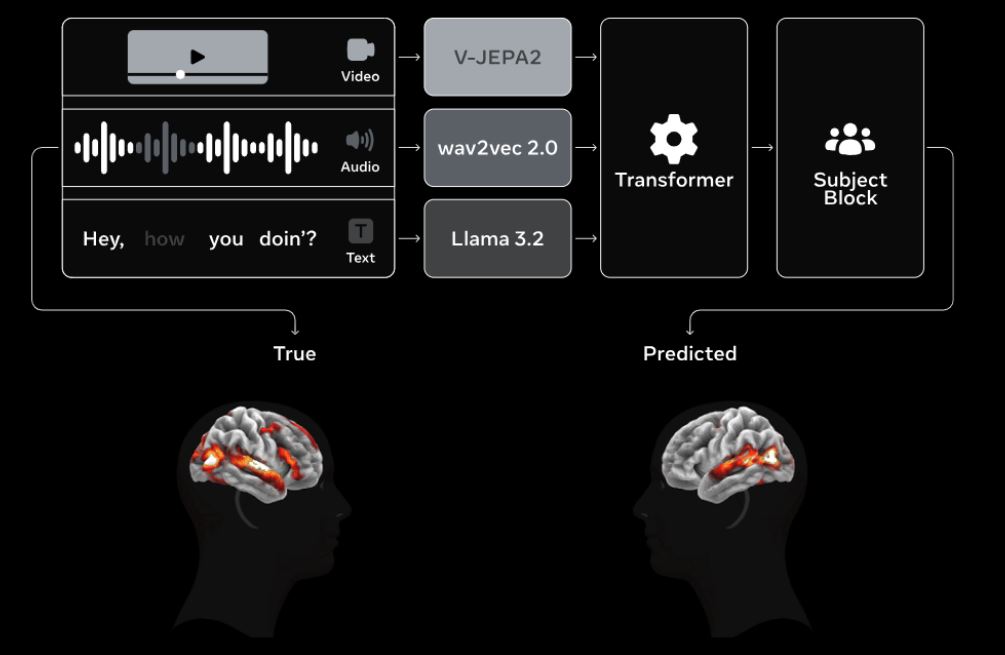
Other researchers are building foundation models trained on thousands of brain scans, essentially trying to create a “GPT for the brain” that can be adapted to many different tasks.
Others are decoding inner speech directly from neural signals, raising exciting possibilities and serious ethical questions.
For now, the takeaway is simple: the most promising brain-computer interfaces might not be the ones where AI replaces human control, but the ones where AI and the brain learn to work together.
And if you think about it, that’s probably how the best collaborations work anyway.
Source: Lee, J.Y., Lee, S., Mishra, A. et al. Brain–computer interface control with artificial intelligence copilots. Nat Mach Intell 7, 1510–1523 (2025). https://doi.org/10.1038/s42256-025-01090-y